


How Do Microschools Work for Neurodivergent Students?

For many families, the question is not whether their child is capable of learning. It is whether their school environment allows that capability to show. If crowded classrooms, missed accommodations, school refusal, or constant stress have become part of daily life, you may be asking: how do microschools work, and could one offer a better fit?
A microschool is a small, relationship-centered learning community. It gives students more individual attention than a conventional school while providing the consistency, structure, and academic accountability that can be difficult to maintain through homeschooling alone. For neurodivergent students, that difference can be meaningful: fewer students to navigate, adults who know their needs, and a learning plan built around both growth and dignity.
What Is a Microschool?
Microschools are intentionally small schools, often serving a limited number of students in each class or learning group. They are not simply a smaller version of a traditional school. The model is designed to be flexible, personalized, and responsive.
In a conventional classroom of 25 or 30 students, a teacher has limited time to notice when a student is overwhelmed, confused, disengaged, or ready for more challenge. In a microschool, small class sizes make it possible to understand the whole student: their learning profile, communication style, sensory needs, strengths, interests, and goals.
That does not mean expectations disappear. A strong microschool combines individualized support with clear routines, meaningful academic goals, and regular progress monitoring. Students are not asked to fit a one-size-fits-all system. Instead, the school creates a structured path that helps each student access rigorous learning.
How Do Microschools Work Day to Day?
The details vary by school, but the strongest microschools balance predictability with personalization. Students generally follow a consistent daily schedule, which can reduce uncertainty and make transitions more manageable. Within that structure, teachers can adjust instruction, pacing, grouping, and support based on what students need.
A typical day may include direct instruction in core subjects, small-group learning, independent work, movement breaks, project-based activities, and time for social-emotional skill building. Because teachers work with fewer students, they can give timely feedback instead of waiting for a test or report card to reveal that a child has fallen behind.
For a student who needs more processing time, that may mean receiving instruction in smaller chunks and having space to ask questions without feeling rushed. For a student who is advanced in a particular subject, it may mean moving ahead rather than repeating content they have already mastered. For a student who becomes dysregulated in noisy or unpredictable settings, it can mean a calmer environment with familiar routines and adults who recognize early signs of stress.
This is not about lowering the bar. It is about removing unnecessary barriers so students can meet high expectations in ways that are realistic and sustainable.
Small Classes Change the Quality of Support
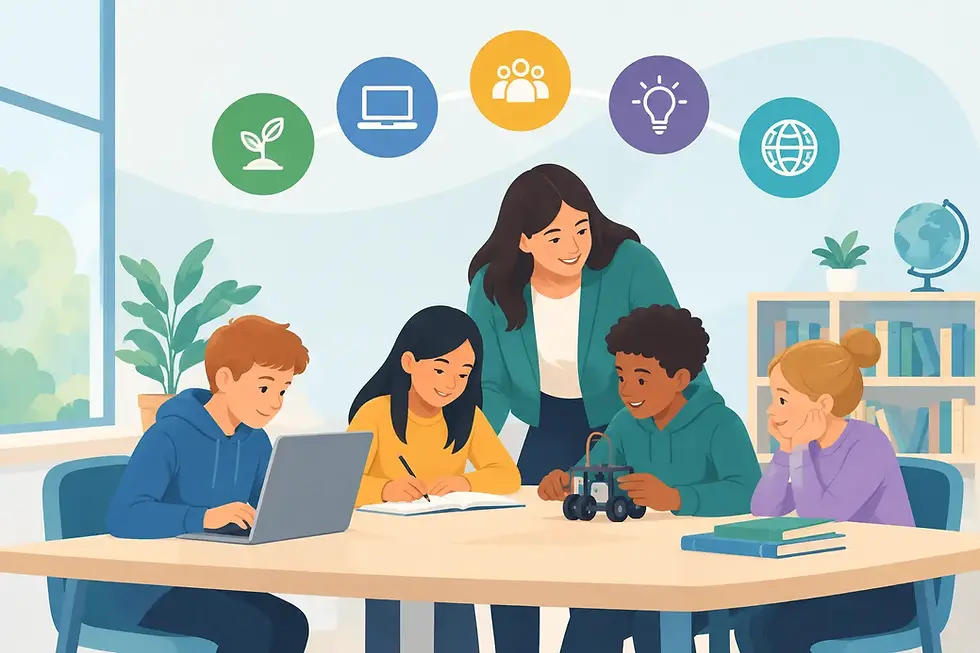
Class size is one of the biggest practical differences in a microschool. At ReThink Microschools, classes are capped at eight students. That small ratio allows educators to build genuine relationships and respond before small challenges become major setbacks.
When an adult knows a student well, support becomes more specific. They can recognize whether a student is avoiding work because it is too difficult, because directions were unclear, because the environment feels overwhelming, or because they need a different way to demonstrate understanding. Those distinctions matter. They lead to better decisions than generic interventions or repeated reminders to “try harder.”
Small groups also make social learning more intentional. Students have opportunities to practice collaboration, communication, conflict resolution, and self-advocacy in a setting where adults can guide interactions in the moment. For many neurodivergent students, social confidence grows when they are not constantly trying to keep up with a large, fast-moving peer group.
Personalized Learning Is More Than Individual Work
Personalized learning is sometimes misunderstood as putting every child alone on a computer with a different assignment. Technology can be useful, but a thoughtful microschool relies on educators, relationships, and careful planning.
Teachers begin by identifying a student’s current academic skills, learning needs, interests, and longer-term goals. From there, they can tailor instruction without isolating the student. One learner may need explicit reading instruction. Another may benefit from hands-on STEM projects that make abstract concepts concrete. A high school student may need support with executive functioning while taking on college-level coursework or career-focused training.
The goal is not for every student to do the same thing at the same time. The goal is for every student to make meaningful progress while remaining part of a real learning community.
The Role of Structure and Emotional Safety
Parents sometimes hear “flexible” and worry that a microschool will lack discipline, routines, or academic direction. A well-designed program should offer the opposite: flexibility within a dependable framework.
Clear expectations, visual schedules, predictable transitions, and consistent adult responses help students know what comes next. That structure is especially valuable for learners with attention differences, anxiety, autism, communication differences, or executive functioning challenges. When students do not have to spend all day guessing what is expected, they can devote more energy to learning.
Emotional safety is equally essential. A safe school is not a school that avoids challenge or allows students to opt out whenever work feels hard. It is a school where students can struggle, ask for help, recover from mistakes, and try again without shame.
In this kind of environment, regulation and academics are not competing priorities. A student who feels understood is often better able to engage in challenging work. A student who has reliable support can gradually build the independence needed to manage frustration, organize tasks, and advocate for themselves.
What Academic Rigor Looks Like in a Microschool
Academic rigor should be measured by the quality of thinking, growth, and preparation a student receives, not by how exhausted they feel at the end of the day. Microschools can deliver serious academics because teachers have more room to meet students where they are and move them forward.
That may include standards-aligned core instruction, writing and research, math problem-solving, science labs, and STEM-focused learning. It may also include opportunities that are often difficult to personalize in a large school, such as speech pathology support, college course access, or career pathways.
For high school students, a strong microschool should keep future options open. Some students may be preparing for college. Others may be ready to explore industry credentials, technical interests, or practical career skills. Both paths deserve respect and careful planning. Career preparation is not a backup plan, and college readiness should not be reserved only for students who learn in conventional ways.
The right program helps students develop the habits that matter beyond graduation: communicating needs, managing responsibilities, solving problems, and seeing themselves as capable learners.
Microschooling Compared With Traditional School and Homeschooling
Microschools often appeal to families who feel caught between two imperfect options. Traditional school can offer community and resources, but the scale may make individualized attention inconsistent. Homeschooling can provide flexibility and relief, but parents may not have the time, teaching capacity, support services, or peer community they want for their child.
A microschool can provide a middle ground. Students benefit from a consistent school setting, trained educators, classmates, and a daily rhythm outside the home. At the same time, families can expect a level of responsiveness that is difficult to sustain in an overcrowded classroom.
Still, microschooling is not automatically the right choice for every child. Families should ask practical questions: How many students are in each group? How are academic goals set and measured? What supports are available? How does the school respond to dysregulation or conflict? What opportunities exist for older students planning for college, work, or independent adulthood?
The answers reveal whether a school is truly personalized or simply small.
What Parents Should Look For
A promising microschool has a clear educational model, not just a welcoming atmosphere. Look for a program that can explain how it balances individualized support with academic expectations, how it communicates progress, and how it helps students grow in independence.
It is also worth paying attention to how staff talk about neurodivergent students. Families deserve a school that recognizes differences without defining children by deficits. The best environments are compassionate without becoming complacent. They honor accommodations and support needs while continuing to ask, “What can this student do next?”
A good school fit can change more than grades. When students feel known, challenged, and safe, they may begin taking academic risks again. They may speak up, reconnect with learning, and build confidence that follows them far beyond the classroom. That is the possibility worth looking for: not a smaller school for its own sake, but a place where your child has the room, support, and expectations to grow into who they are capable of becoming.


Comments